Head to head · Updated Sep 27, 2026
Anker SOLIX C1000 Gen 2 vs BLUETTI Elite 100 V2
Two of the newest 1 kWh stations, both about $500, both around 25 lb with 10 ms UPS. Anker wins on output and charging speed; BLUETTI on solar input.
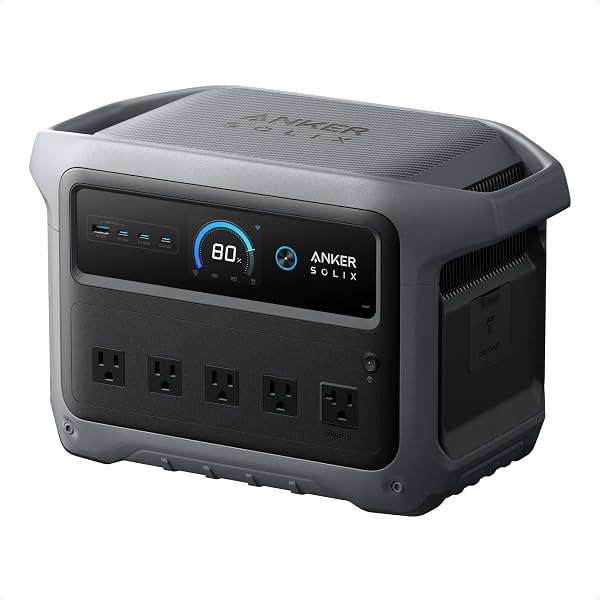
Anker
Anker SOLIX C1000 Gen 2
- Capacity
- 1,024 Wh
- Output
- 2,000 W
- Weight
- 24.9 lb
- Recharge
- 49 min

BLUETTI
BLUETTI Elite 100 V2
- Capacity
- 1,024 Wh
- Output
- 1,800 W
- Weight
- 25 lb
- Recharge
- —
Quick verdict
Which one should you buy?
Grid charging and higher loads: Anker C1000 Gen 2. Solar-first: BLUETTI Elite 100 V2.
Choose the Anker SOLIX C1000 Gen 2 if…
You want the most power (2,000 W vs 1,800 W), the fastest wall charge (full in 49 minutes) and a time-of-use mode that saves on electricity.
Check priceChoose the BLUETTI Elite 100 V2 if…
You'll charge mostly from solar: it accepts 1,000 W vs 600 W, and it's a little smaller at 17 liters with a 30 dB silent mode.
Check priceEditor scores
How they stack up
- Anker SOLIX C1000 Gen 2
- BLUETTI Elite 100 V2
Key differences
By the numbers
- BLUETTI Elite 100 V2 costs less: $499.00 vs $499.99 ($1 difference, Amazon prices as of Sep 27, 2026)
- Anker SOLIX C1000 Gen 2 has more continuous output: 2,000 W vs 1,800 W
- BLUETTI Elite 100 V2 handles bigger startup surges: 3,600 W vs 3,000 W
- BLUETTI Elite 100 V2 accepts more solar: 1,000 W vs 600 W
- Anker SOLIX C1000 Gen 2 is lighter: 24.9 lb vs 25 lb
- Anker SOLIX C1000 Gen 2 is rated higher on Amazon: 4.7★ (1,642 ratings) vs 4.6★ (1,781)
Full specs
Spec by spec
| Spec | Anker SOLIX C1000 Gen 2 | BLUETTI Elite 100 V2 |
|---|---|---|
| Battery | ||
| Capacity | 1,024 Wh | 1,024 Wh |
| Battery chemistry | LiFePO4 | LiFePO4 |
| Rated cycles | 4,000 cycles | 4,000 cycles |
| Output | ||
| AC output (continuous) | 2,000 W | 1,800 W |
| Surge / peak | 3,000 W | 3,600 W |
| Charging | ||
| Max AC charging input | 1,600 W | 1,200 W |
| Full charge from the wall | 49 min | — |
| Charging speed (claimed) | Full in 49 min at 1,600 W (HyperFlash, enable in app) | 0–80% in about 45 min (1,200 W AC) |
| Max solar input | 600 W | 1,000 W |
| UPS switchover | 10 ms | 10 ms |
| Size & build | ||
| Weight | 24.9 lb | 25 lb |
| Dimensions | 15.1 × 8.2 × 9.6 in | 12.6 × 8.5 × 9.8 in |
| Noise (claimed) | — | 30 dB |
| Other | ||
| App control | Anker app | Wi-Fi + Bluetooth |
| Warranty | 5 years | 5 years |
| Editor scores (0–10) | ||
| Capacity | 6 | 6 |
| Output | 8 | 8 |
| Charging | 10 | 8 |
| Solar input | 7 | 9 |
| Portability | 4 | 4 |
| Battery life | 9 | 9 |
| Value | 9 | 9 |
| Overall editor score | 7.7 | 7.7 |
“Best” marks the stronger value in each row. A dash means the value isn’t published. Anker SOLIX C1000 Gen 2 wins 3 spec rows, BLUETTI Elite 100 V2 wins 2. Scores follow our rating rules.
Pros & cons
What owners and specs say
Anker SOLIX C1000 Gen 2
- 2,000 W output
- Full in 49 minutes
- 600 W solar, 10 ms UPS
- 4,000 cycles to 80%, 5-year warranty
- Fast charging must be enabled in the app
- Not expandable
- Sold by AnkerDirect, not Amazon
BLUETTI Elite 100 V2
- 1,000 W solar input
- Compact 25 lb
- 10 ms UPS, 30 dB silent mode
- 4,000+ cycles, 5-year warranty
- AC outlet count not stated on the listing
- Sold by BLUETTI, not Amazon
- Some listing reviews are for older models
Frequently asked questions
Which lasts longer?
Both are rated for 4,000 cycles to 80% capacity and carry 5-year warranties.
Which runs a microwave better?
The Anker, with 2,000 W continuous. Many 1,000 W microwaves draw about 1,500 W, which both can handle.
Which is lighter?
They're nearly identical: 24.9 lb for the Anker and 25 lb for the BLUETTI.
More head-to-heads
- Jackery Explorer 1000 v2 vs EcoFlow DELTA 3 Classic
- Jackery Explorer 300 vs Anker SOLIX C300
- EcoFlow RIVER 3 Plus vs BLUETTI Elite 30 V2
- Anker SOLIX S2000 vs Jackery Explorer 2000 v2
- EcoFlow DELTA 3 vs EcoFlow DELTA 3 Classic
- Jackery HomePower 3600 Plus vs EcoFlow DELTA Pro