Reader-supported: we may earn a commission when you buy through our links. Learn more

Buying guide · Updated Sep 27, 2026

The best portable power stations in 2026

A portable power station is a big LiFePO4 battery with an inverter, outlets and a charger in one box. The right one depends on what you plug in: a 300 Wh unit handles phones, laptops and a CPAP without heat; a 1 kWh unit runs a fridge through a typical outage; 2 kWh and up covers multi-day outages and RVs.

We rank every station by our editor score, which weighs capacity and value most, then output, battery longevity, charging speed, solar input and portability. Use the runtime calculator to check any pick against the devices you actually own.

Quick picks

Power stationCapacityOutputScore
#1BLUETTI Elite 300Best overall3,014 Wh2,400 W8.2Amazon
#2Jackery HomePower 3600 PlusRunner-up3,584 Wh3,600 W7.8Amazon
#3BLUETTI Elite 100 V2Also great1,024 Wh1,800 W7.7Amazon
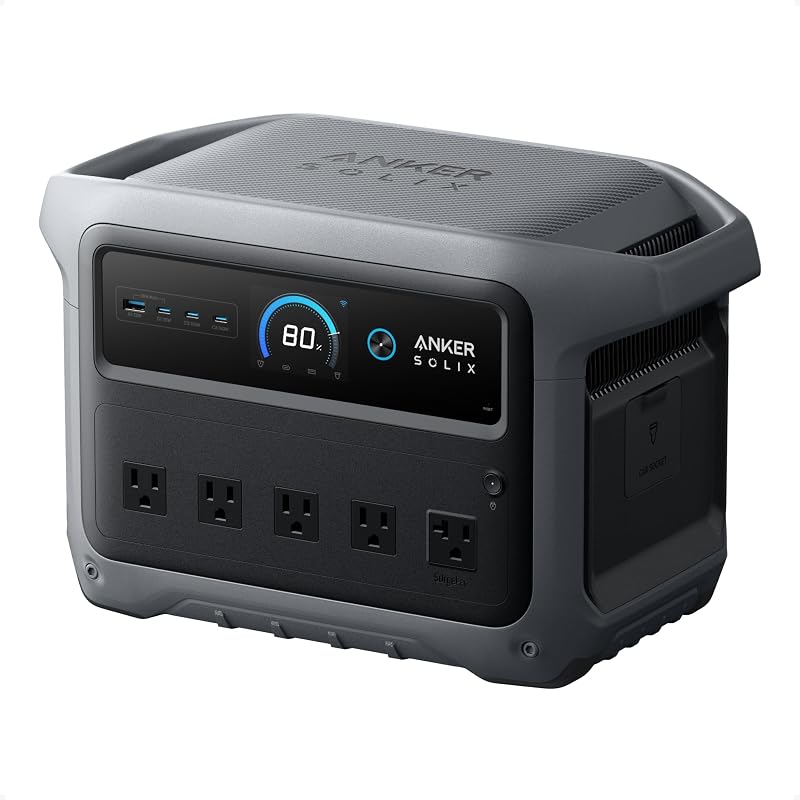
#4Anker SOLIX C1000 Gen 21,024 Wh2,000 W7.7Amazon
#5BLUETTI AC1801,152 Wh1,800 W7.5Amazon
Compare the picks side by side
#1BLUETTI Elite 300

Best overall

BLUETTI Elite 300

4.7 (241)8.2

Why it's here: The best big power station for RVs, and the lowest cost per Wh here.

Capacity
3,014 Wh
Output
2,400 W
Weight
58 lb
Recharge
2.7 h
  • 3,014 Wh for about $1,100
  • TT-30 RV outlet + 12 V/30 A
  • 1,200 W solar
  • 58 lb
  • Not expandable
$1,098.99$1,499.00−27%Amazon price as of Sep 27, 2026
#2Jackery HomePower 3600 Plus

Runner-up

Jackery HomePower 3600 Plus

4.6 (194)7.8

Why it's here: The best portable-ish home backup here — plan for its weight and idle draw.

Capacity
3,584 Wh
Output
3,600 W
Weight
77.2 lb
Recharge
2.5 h
  • 3,600 W, 7,200 W surge
  • Expandable to 21.5 kWh
  • 30 A RV outlet, 240 V when paired
  • 77 lb
  • ~34 W idle draw
$1,709.00$1,899.00−10%Amazon price as of Sep 27, 2026
#3BLUETTI Elite 100 V2

Also great

BLUETTI Elite 100 V2

4.6 (1,781)7.7

Why it's here: The best 1 kWh station for solar, and one of the best values here.

Capacity
1,024 Wh
Output
1,800 W
Weight
25 lb
Recharge
—
  • 1,000 W solar input
  • Compact 25 lb
  • 10 ms UPS, 30 dB silent mode
  • AC outlet count not stated on the listing
  • Sold by BLUETTI, not Amazon
$499.00$899.00−44%Amazon price as of Sep 27, 2026
#4Anker SOLIX C1000 Gen 2

Pick #4

Anker SOLIX C1000 Gen 2

4.7 (1,642)7.7

Why it's here: The best 1 kWh power station you can buy right now.

Capacity
1,024 Wh
Output
2,000 W
Weight
24.9 lb
Recharge
49 min
  • 2,000 W output
  • Full in 49 minutes
  • 600 W solar, 10 ms UPS
  • Fast charging must be enabled in the app
  • Not expandable
$499.99$599.00−17%Amazon price as of Sep 27, 2026
#5BLUETTI AC180

Pick #5

BLUETTI AC180

4.6 (2,620)7.5

Why it's here: The best value per watt-hour among the 1 kWh stations — if you don't mind the weight.

Capacity
1,152 Wh
Output
1,800 W
Weight
37.4 lb
Recharge
60 min
  • 1,152 Wh for $449
  • 1,800 W output, 2,700 W lifting
  • Full recharge in about an hour
  • Heavy at 37.4 lb
  • 20 ms UPS
$449.00$499.00−10%Amazon price as of Sep 27, 2026
Check the picks against your devicesTick your fridge, CPAP, router or anything else and see how long each pick lasts

Also considered

Ranked lower on this guide's criteria.

How to choose

Capacity (Wh) sets the runtime

Divide usable watt-hours (about 85% of the rating once the inverter's losses are counted) by your devices' watts. A 1,024 Wh station runs a 40 W CPAP for about 21 hours.

Output (W) sets what you can plug in

Add up everything that runs at the same time. Fridges, pumps and air conditioners also need a startup surge two to five times their running watts.

LiFePO4 lasts much longer

Every current model here except one uses LiFePO4 cells rated for 3,000 or more cycles — roughly 10 years of regular use.

Charging speed matters before storms

Newer models refill from the wall in about an hour. Older or budget models take three to four.

Frequently asked questions

What size power station do I need?

Add up the watt-hours your devices use per day (watts × hours) and divide by 0.85. A fridge, router, lights and phones need about 1,500–2,000 Wh a day; a CPAP without heat about 300–400 Wh a night.

Can a power station run a refrigerator?

Yes, if its output exceeds the fridge's startup surge (often 600–1,200 W) and it has enough capacity. A typical full-size fridge uses 1–1.5 kWh a day, so a 1 kWh station covers most of a day and a 2 kWh station more than a day.

Is a power station the same as a generator?

It does the same job without fuel, noise or fumes, so it can be used indoors. It stores less energy than a gas generator's tank, but you can recharge it from the wall, a car or solar panels.